Self-Hosted DRM Streaming Panel

DRM Streaming Panel Widevine, PlayReady, HLS

Self-hosted DRM streaming panel that decrypts Widevine, PlayReady and FairPlay.
Converts DASH DRM and HLS DRM to clean HLS output in real-time.
Auto-fetch & refresh MPD tokens and decryption keys, one-cmd install.

One-Line Install — DRM Streaming Server
$ bash <(curl -s https://streamora.dev/updates/install.sh)
Ubuntu, Debian, CentOS, RHEL, Rocky, AlmaLinux, Fedora — run as root
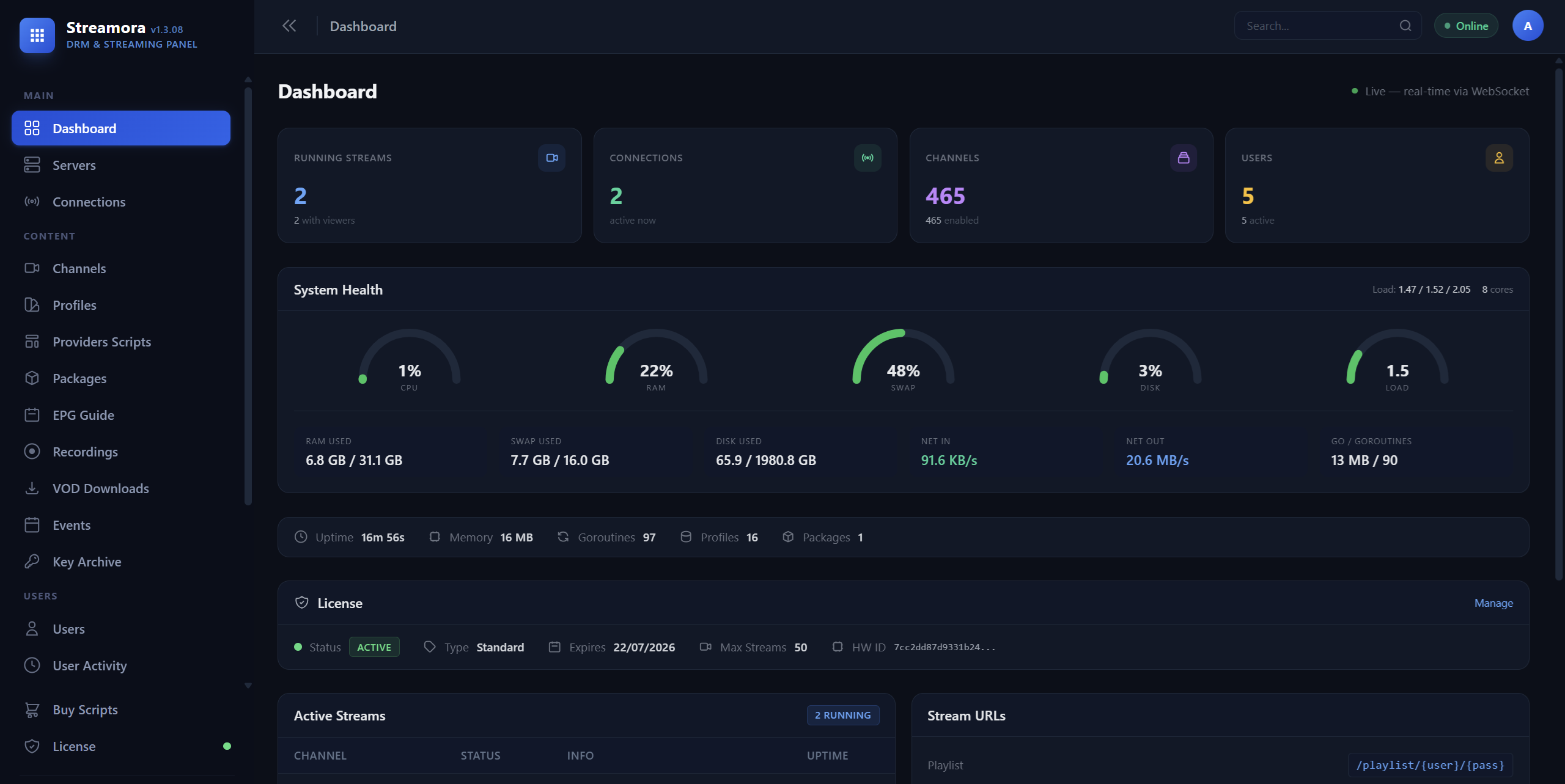
Streamora Dashboard
Streamora DRM Streaming Panel Dashboard — Real-time stream monitoring, system health, license management

Streamora Service Commands

Manage your Streamora server with these systemd commands. Click any command to copy it to your clipboard.

DRM Streaming Panel Features

Everything you need to decrypt, convert, and serve DRM-protected streams from a single self-hosted server.

🔒

Widevine & PlayReady Decryption

Built-in Widevine L1/L3, PlayReady, FairPlay, and ClearKey DRM support. Auto key acquisition via CDM, manual key input, or provider script-based decryption. CENC and CBCS encryption modes.

🌐

Multi-Provider Script System

Python-based provider scripts with auto-sync, auto key refresh, and interactive terminal. Encrypted scripts (SENC) tied to license + hardware. One panel manages all DRM providers.

Internal Remux Engine

In-process fMP4 to MPEG-TS remuxer converts DASH DRM to HLS without FFmpeg. Parses ISO BMFF, decrypts AES-128-CTR CENC, converts H.264/H.265, wraps AAC/AC-3/E-AC-3.

💻

Professional Admin Dashboard

Real-time DRM stream monitoring, channel management, EPG, user management, recording, and download manager. WebSocket live updates, dark mode, fully responsive.

🔄

MPD to HLS Converter

Converts MPEG-DASH MPD manifests to HLS playlists in real-time. Handles SegmentTemplate, SegmentList, SegmentBase formats. Live edge detection with automatic segment deduplication.

🛡

Auto DRM Key Acquisition

Automatically acquires Widevine and PlayReady decryption keys from license servers using CDM devices. Keys cached in database, auto-refreshed on expiry. Zero manual intervention.

DRM Server Architecture

Built in Go for performance. Single binary, zero runtime dependencies.

DRM Processing Pipeline

  • Internal remux: fMP4 CENC decrypt + TS mux in-process (no FFmpeg)
  • FFmpeg remux mode for HLS DRM and complex transcoding
  • Named pipe architecture for real-time DRM decryption
  • Adaptive segment pacing with CDN token refresh
  • Multi-quality output with per-track selection
  • Live and on-demand DRM stream modes

Reliability & Scale

  • Stall detection watchdog with auto-recovery
  • Auto-restart on failure with exponential backoff
  • Multi-server load balancing with SSH auto-deploy
  • Binary integrity verification (HMAC-SHA256)
  • License validation with hardware binding
  • Stream recording, scheduled events, DVR

Supported DRM & Streaming Protocols

DASH + Widevine HLS + Widevine DASH + PlayReady HLS + FairPlay HLS + ClearKey CENC / CBCS Clear DASH / HLS Direct Streams

Input: MPEG-DASH (MPD), HLS (M3U8), Smooth Streaming, direct URLs. Output: HLS (MPEG-TS or fMP4), MPEG-TS, SRT. DRM: Widevine L1/L3, PlayReady, FairPlay, ClearKey, AES-128.

DRM Provider Scripts

Ready-made Python scripts for 23+ DRM content providers. Auto-sync channels, auto-configure profiles, auto-refresh tokens and decryption keys.

23 Provider Scripts Available

Browse the full catalog — 3 free, 20 paid. Each script ships with a complete setup guide including credentials, proxy config, and provider-specific notes.

DRM Streaming Panel Pricing

Simple, transparent licensing for your DRM streaming server.

Standard
1 Month
1 month license with 1000 concurrent streams
€ 29
1 month
1,000 streams 1 month
Get Started
Standard
6 Months
6 month license with 3,000 concurrent streams
€ 170
6 months
3,000 streams 6 months
Get Started
Unlimited
Lifetime
Lifetime license with 20,000 concurrent streams
€ 1999
Lifetime
20,000 streams Lifetime
Get Started

Frequently Asked Questions

Common questions about DRM streaming panels and Streamora.

What is a DRM streaming panel?
A DRM streaming panel is server software that decrypts DRM-protected streams (Widevine, PlayReady, FairPlay) and converts them to standard HLS or MPEG-TS output for delivery to end users. Streamora handles this with an internal remux engine that processes fMP4 CENC-encrypted content in real-time without requiring FFmpeg.
How does Streamora convert DASH DRM to HLS?
Streamora fetches the DASH MPD manifest, downloads encrypted fMP4 segments, decrypts them using Widevine or PlayReady keys (auto-acquired or manually configured), then remuxes the decrypted content into MPEG-TS segments with an HLS playlist. This happens in real-time using either the internal Go remux engine or FFmpeg via named pipes.
Does Streamora support Widevine and PlayReady DRM?
Yes. Streamora supports Widevine L1/L3, PlayReady, FairPlay, and ClearKey DRM systems. It can automatically acquire decryption keys from license servers using CDM devices, or you can provide keys manually. The auto key dump feature extracts keys without manual intervention.
What is the internal remux engine?
The internal remux engine is Streamora's built-in Go-based pipeline that converts fragmented MP4 (fMP4) with CENC encryption directly to MPEG-TS HLS output without requiring FFmpeg. It parses ISO BMFF boxes, decrypts AES-128-CTR samples, converts H.264/H.265 to Annex-B format, wraps AAC/AC-3/E-AC-3 audio, and builds HLS playlists — all in-process with zero external dependencies.
What is the MPD to HLS converter?
Streamora's MPD to HLS converter processes MPEG-DASH manifests (MPD files) — including DRM-encrypted ones — and outputs clean HLS (M3U8 + TS segments). It handles SegmentTemplate, SegmentList, and SegmentBase MPD formats, with automatic segment deduplication for live streams and CDN token refresh for expiring URLs.
How do I install Streamora?
Streamora installs with a single command: bash <(curl -s https://streamora.dev/updates/install.sh). The installer supports Ubuntu, Debian, CentOS, RHEL, Rocky Linux, AlmaLinux, and Fedora. It automatically installs all dependencies (FFmpeg, mp4decrypt, Python), creates the systemd service, and starts the admin panel.
Can Streamora handle live DRM streams?
Yes. Streamora supports both live and on-demand DRM streams. For live streams, it continuously polls the MPD/M3U8 manifest for new segments, decrypts them in real-time, and serves them as a live HLS output. CDN token refresh keeps streams running through URL expiration. Stall detection with auto-recovery ensures maximum uptime.

Start Your DRM Streaming Server

Install in under 2 minutes. One command, fully automated setup. Widevine, PlayReady, and FairPlay ready.